

Custom Jacquard Elastic Artwork: Logo Repeat and Sample Approval for Brands
Before commissioning a sample, approve the custom jacquard elastic artwork as a versioned pack. Include the logo at its intended size, the repeat layout, the visible face and the proposed join position.
Record digital proof approval separately from approval of the physical band under agreed viewing and stretch conditions.
At Wubao, we offer jacquard elastic bands with logos and patterns woven into the fabric. For a brand preparing a bulk order, start with a drawing of what the finished band should show.
The checklist below is a recommended way to prepare that drawing and keep sample comments attached to the right revision.
Build a versioned jacquard artwork handoff
Give one person responsibility for issuing the current artwork. The designer may change the lettering while a buyer confirms colors, so collect those decisions into one revision before requesting the next proof. Keep the superseded version for reference, clearly marked as replaced.
An editable logo and a preview serve different purposes. The editable artwork supports design changes; the preview shows the appearance the brand intends to approve.
Include any linked graphics needed to open the file correctly, and check the font handoff with the designer before sharing.
Vector graphics retain defined edges when scaled. A small raster image contains a fixed grid of pixels, which can make close inspection difficult when enlarged.
Ask which file format suits the selected product and whether the supplied artwork needs preparation before a weaving file can be made.
For each design, put these details together:
- The design name, artwork filename and revision identifier.
- The intended band width, logo height and measurement units.
- The reading direction and a label identifying the visible face.
- The logo and background color references, with their positions marked.
- The repeat dimensions, preview scale and person authorized to approve changes.
Label each colorway separately if its approval will be handled separately. A comment about light lettering on a dark band should point to that version, rather than leave the supplier to infer which preview the buyer meant.
Resolve the decoration route before spending time on final artwork. Our sublimation versus jacquard comparison covers that earlier choice. Once woven branding is selected, keep the handoff focused on the intended woven result and its sample review.
Map logo repeats around the join
A repeat is the complete unit that recurs along the band, including the space after the logo. Show its boundaries explicitly. Two drawings can use the same lettering and still produce different layouts because the gap between successive logos differs.
Place several repeats in a mock-up of the intended finished band. Mark the join and any area where the brand does not want lettering, such as a covered section or a position reserved for another label. Keep those marks separate from the artwork itself.
Use the mock-up to ask a specific question: does a complete logo remain visible where it matters on this garment? Trace the pattern across the proposed join and check whether a word ends abruptly or an awkward gap appears beside it.
Treat this as a placement discussion. Confirm the intended relationship between the repeat and garment assembly with the relevant supplier; an attractive drawing alone does not establish how consistently that position can be achieved in production.
Different garment sizes deserve their own check. Avoid assuming that a layout approved for one finished band length will place the join in the same part of the repeat on another.
Record whether the priority is a complete central logo, balanced spacing or another identified feature.
For an illustrative review, imagine that the proposed join passes through the last letter. Mark the affected letter and ask for a revised placement drawing. Compare the new drawing against the unchanged logo artwork before deciding whether a new physical sample is needed.
Do not quietly squeeze the logo to make the layout fit. If proportions, spacing or repeat length change, identify the change and return it to the brand approver. Show the approver the changes before requesting a sample of the revised design.
Review letter edges at actual band size
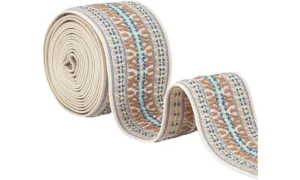
Review the logo at its intended physical size, then enlarge it to inspect individual details. On a printed proof, check the printed band width against the stated dimension so that page scaling does not mislead the review.
Look at the smallest enclosed spaces, narrow strokes and gaps between adjacent letters. Identify the exact feature that must remain recognizable. A comment such as open the space inside the second letter gives the designer a clearer task than make the logo sharper.
Our woven logo design overview explains the relationship between branding and the woven band. For the artwork approval itself, keep the digital drawing and physical result distinct.
Crisp vector edges are a property of the drawing; the sample is where the buyer checks the resulting woven lettering.
Ask for feasibility feedback at the chosen width. If a detail needs simplification, have the proposed change shown in a new proof. Agree on that change before treating the sample as a reference for the original design.
The following log is illustrative. It shows how to record a requested revision, without implying that these defects occurred on a Wubao order.
|
Review observation |
Requested revision or check |
Record to retain |
|
A letter opening is unclear in the proof |
Show a revised opening at intended size |
Marked feature and artwork revision |
|
The gap after the logo looks uneven |
Review spacing across consecutive repeats |
Repeat dimensions and approved preview |
|
The logo looks distorted during sample stretching |
Record the viewing condition and discuss the affected feature |
Sample identity, observation and next decision |
Keep comments about letter shape separate from comments about the whole repeat. Combining both into a general request to improve the pattern makes it harder to check the next version against the request.
Separate digital proof sign-off from stretched-sample approval
Digital proof approval should identify the drawing being accepted and any outstanding questions. Physical sample approval should identify the band actually reviewed. Link the two records, including the artwork revision the sample is intended to represent.
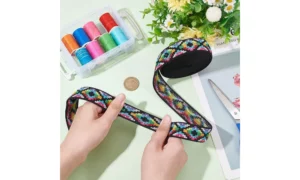
For the physical review, agree how the band will be viewed in its relaxed and stretched states. Record the conditions used so that another reviewer can repeat the observation. Stretching a loose piece differently each time makes comments about logo appearance harder to compare.
Inspect the same lettering and repeat features that were marked on the proof. Note the sample identity beside each photograph and comment.
If an image shows a problem, retain enough of the band to identify its location as well as a close view of the affected detail.
Visual approval addresses appearance under those recorded conditions. Where the order also requires measured elastic performance or durability, agree the test method and acceptance criteria separately. A satisfactory logo photograph cannot replace those results.
Our OEM and ODM services provide a route to discuss the custom order. Before commissioning development, ask about the required files, sample scope, charges and schedule for the specific design. Put any unresolved items in the request so they can be answered together.
Close the artwork review with a short decision record. It should name the approved revision, repeat layout and colorway, identify the physical sample when available, and state who accepted each stage. Keep requested changes open until the revised proof or sample has been reviewed.
For a repeat order, refer back to that record and identify any change in width, colorway or design. Ask whether the change needs another proof or sample review before using the earlier approval as the order reference.
Send us an artwork inquiry with the versioned logo file, intended band width, repeat mock-up and quantities by design. Flag the lettering or placement decisions still open, so the feasibility discussion starts with the features your brand needs to approve.


