

Resistance Band Quality Testing: What Buyers Should Check Beyond Strength Labels
A resistance-band report arrives with a force value, a cycle count and the word “pass.” Before approving it, ask what each result refers to. Which specimen was tested? At what extension? What changed after the repeated pulls? Was colour transfer checked wet or dry?
For resistance band quality testing, we recommend three separate questions: how the specimen behaves during an initial measured pull, what remains after an agreed stretching sequence, and how its colour behaves under the selected exposure. Give each question its own result and acceptance requirement.
If you are reviewing our resistance band range, use the product reference to start that discussion. A catalogue description identifies an item. Ask for the test record that answers your particular purchasing question.
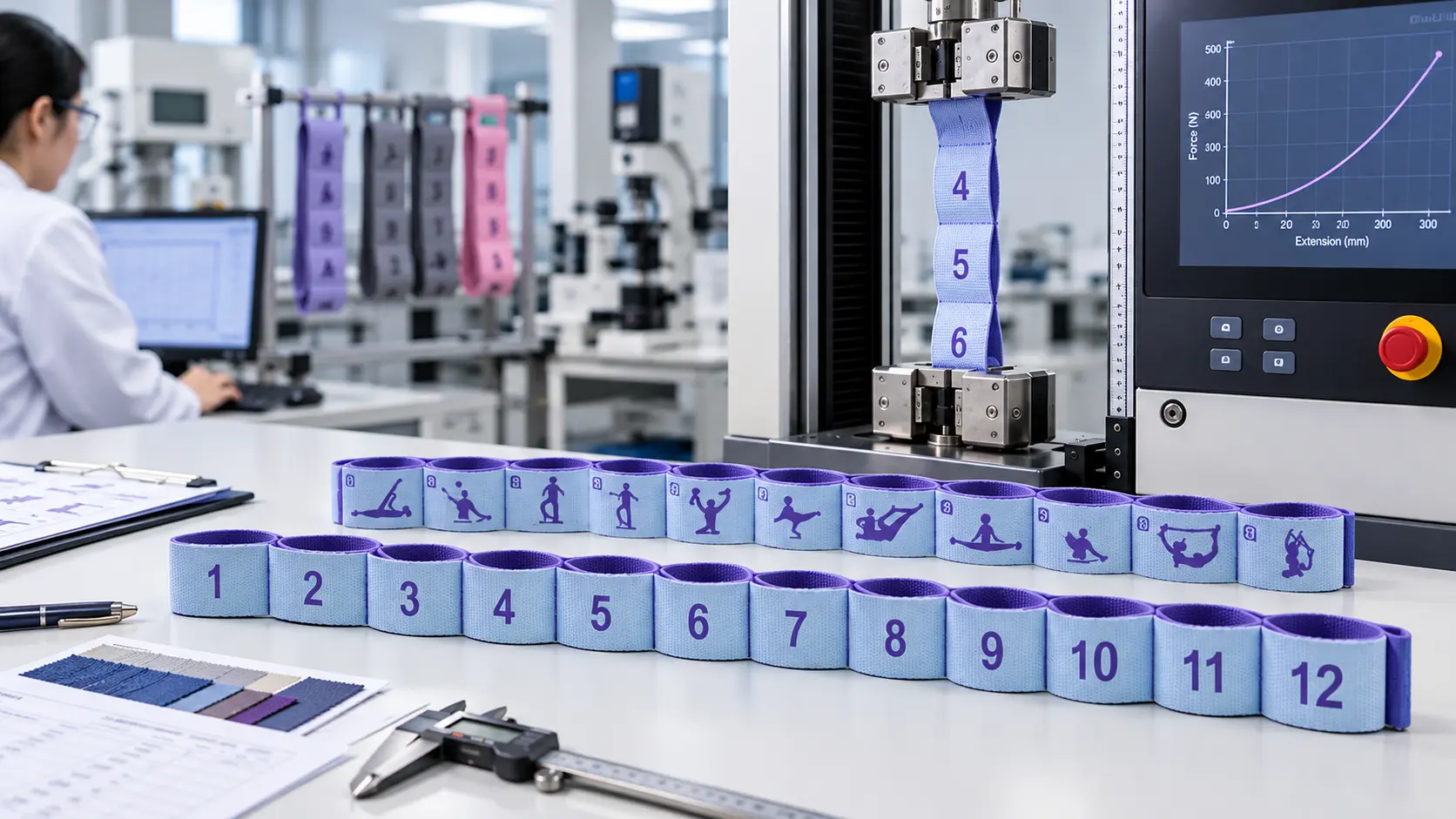
Identify the specimen before reading the numbers
Put a photograph beside the report. Mark the tested section, the grip locations and any loop or joined area included in the setup. We would want another person to be able to pick up the same design and identify exactly what went into the machine.
Notre eight-setting adjustable band has numbered settings and integrated handle loops. For a test involving that design, specify the selected positions and show how the specimen was mounted. Do not leave the reader to reconstruct the setup from the product name.
Ask whether the report concerns fabric cut from the band or the finished assembly. For an assembled sample, request photographs of the loops and joins before and after testing. Limit the decision to the part actually examined; record any untested area as an open question.
Consider a hypothetical pair of reports: one says “fabric strip,” while the other says “finished loop.” We would first send them back for clarification of the specimen and mounting arrangement. A neat side-by-side force table should wait until those descriptions are clear.
One specimen reference should follow the item through the photographs, readings and retained sample. How many pieces were examined? We would want to see each reading as well as the average.
In a hypothetical review, if the summary names five specimens but supplies a single value, our next request would be the individual results, not a fresh batch of samples.
Read the first pull as a baseline
A force reading needs a measurement point. On the report we would look for the starting gauge length, the extension or load where the reading was taken, and the units. The speed and preparation or conditioning belong nearby.
For our review, an attached setup sheet is preferable to a condition mentioned once in an email. Could a colleague understand the number without that email?
ASTM D4964 is one reference to discuss with the laboratory. The method concerns elastic-fabric tension and elongation measured on a constant-rate-of-extension machine; its scope calls for selected or mutually agreed measurement tensions and elongations. We would start with the specimen and the question.
The laboratory should confirm the fit before the method enters the order.
In its public guidance, ASTM makes comparability conditional: the machine, extension rate, maximum load or extension, and specimen specifications need to be comparable. Two different numbers therefore deserve a look at the setups first. We would hold the stronger-or-weaker decision until that comparison is possible.
For example, imagine a report that gives a force but omits the extension point. We would mark that result “clarification needed.” Request the missing condition and the relevant curve or reading. There is no need to invent a tolerance just to complete the approval form.
The wider product brief belongs in our OEM specification guide. Here, we would keep the first-pull record beside the later results. It needs enough detail to say what was measured, where the reading was taken and which units were used.
That is the baseline we want to come back to.
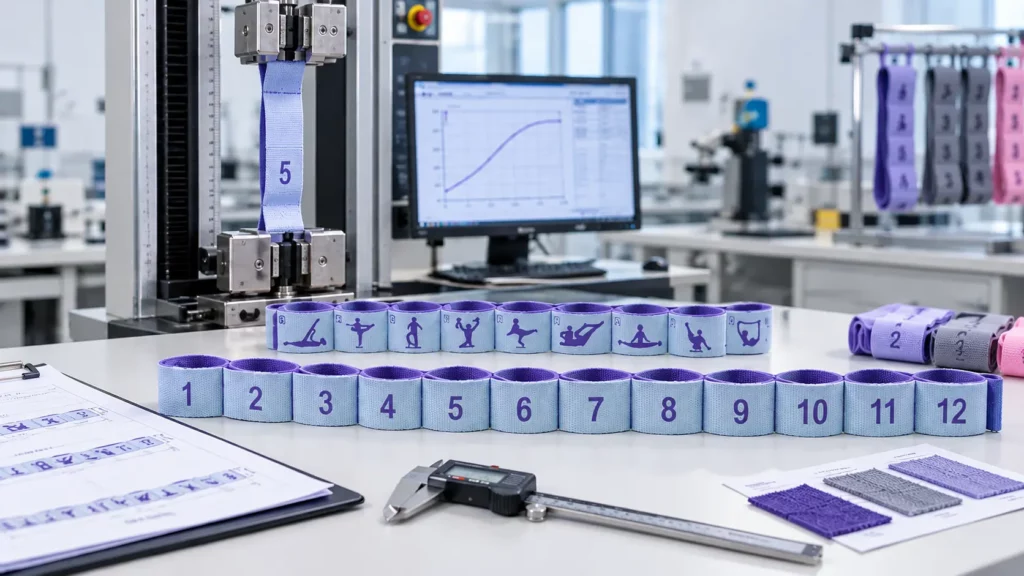
Ask what happened during repeated stretching
“How did it look after the last cycle?” is a useful opening question for a fatigue inquiry. We would follow it with another: “What was measured again?” Our suggested report separates the cycling procedure from the observations and the later readings.
Completing a sequence is only one of the answers we are requesting.
The procedure is a conversation to finish before cycling begins. We would agree the loading or extension range, speed, pauses and cycle count with the supplier or laboratory, together with the stopping conditions. A method reference and version should accompany that agreement.
Any departure needs a note next to the results. An unrelated product listing is no basis for choosing the count; we would ask the laboratory to propose a procedure for this construction.
For the record of the run, our questions are quite plain. How many cycles were completed, and why did it stop? An early stop should stay in the file with the original photographs and notes. We would give a replacement its own reference and show its results separately.
The first specimen should still be visible when someone reviews the replacement.
For the post-cycle inspection, our suggested photo sheet has room for a whole-band view and close views of the edges, loops and joins. Beside each view, leave space to note loose yarns, opened stitching or visible damage.
A length requirement deserves a separate entry: relaxed length, measured after the rest interval agreed in the procedure. We would keep the interval visible beside the measurement.
We would take the repeat force reading under the conditions defined for the baseline, then place both readings on the same sheet with their units and specimen references. A percentage change needs its starting value too. We would leave an unexplained percentage open for clarification.
A report saying only “completed the cycles” leaves your post-cycle requirements unanswered. We would ask for the missing observations and measurements. Keep any product-life statement outside the approval unless you have separate evidence supporting that particular claim.
Match the colour check to the contact
For colour, begin with the contact that concerns you. Perhaps the question is rubbing against clothing; perhaps it is perspiration, cleaning or light. AATCC has separate methods for these exposures, including crocking, perspiration, laundering and light.
We would name the requested assessment rather than approve a report headed only “colourfastness pass.”
AATCC TM8 concerns colour transfer by rubbing from a textile surface to another surface. The public summary describes procedures with white test cloth both dry and wetted with water.
For a report using this method, we would want the condition and the named grading scale beside the assessment. “Rubbing tested” would still leave us with a question.
We suggest separate spaces for the dry result and wet result where both are requested. Attach the specimen reference and any treatment carried out before testing. For a printed area, ask the laboratory to identify the tested location and confirm whether the chosen method can address it.
Do not turn the laundering entry in a standards directory into a washing instruction for the finished product. For a cleaning-related inquiry, supply the intended care instructions and ask the laboratory to recommend a relevant assessment. Have the cleaning conditions written into the request before proceeding.
À Wubao, we recommend keeping colour approval and resistance approval as distinct decisions. Specify the required colour assessment and acceptance level with the buyer and laboratory; leave no one to guess what “good enough” means after the report arrives.
Use the report to make a specific decision
Here is a suggested review sheet. Complete it with your agreed requirements and actual results; the questions are prompts, not universal pass limits.
|
Review area |
What to request |
Question before approval |
|
Initial pull |
Specimen, setup, reading point, units and result |
Can I identify the condition behind this value? |
|
Repeated stretching |
Agreed procedure, completed cycles, stopping notes and post-cycle results |
Did the report answer our after-cycling requirements? |
|
Colour exposure |
Method, exposure condition, grading scale and result |
Is this the exposure we asked to assess? |
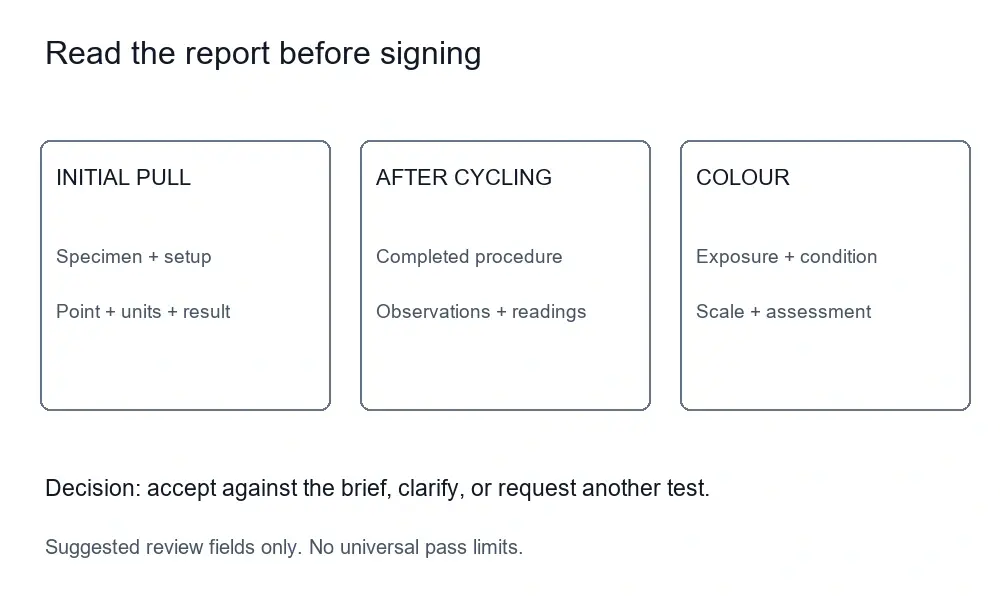
At the end of the review, we would write the outstanding question in ordinary language. For example, a suggested note might read: “The force value is shown, but the extension point is missing. Please add it to this report.” That calls for clarification.
Where a different setup or an untested feature is involved, we would discuss the need for another measurement with the laboratory.
An acceptance entry can be equally specific: identify the requirement, cite the corresponding result and close that item. If a requested wet-rubbing assessment has not arrived, keep that item open rather than guessing its outcome.
We would retain the original report together with the reply so the next reviewer can follow the question and its resolution.
You can discuss the test plan with us using the marked report and specimen reference. Tell us which exposure concerns you and which entry is still unclear. We would begin there, with the question left open on your review sheet.


