

How to Specify Resistance Bands for OEM Manufacturing: A Buyer’s Guide
Introduction
Ordering custom resistance bands for OEM production requires more than specifying the band size or resistance level. Buyers need to define the product format, material, dimensions, resistance requirements, markings, attachments, packaging, and sample approval criteria before moving into bulk production.
A clear specification helps reduce misunderstandings between the buyer and manufacturer, improves sample accuracy, and creates a consistent reference for repeat orders.
In this guide, we explain the key specifications buyers should confirm when developing custom resistance bands with anOEM manufacturer.
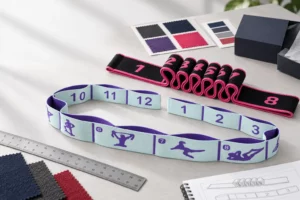
Resistance Band OEM Specification Checklist
|
Spécification |
What to Confirm |
|
Type de produit |
Adjustable loop band, numbered stretch strap, continuous loop, handled band, or another defined form. |
|
Matériel |
Known material preference or a request for supplier recommendation. |
|
Finished Size |
Relaxed length, width, thickness if required, and measurement method. |
|
Resistance |
Label/level information or a measured resistance requirement with an agreed test method. |
|
Couleur |
Color reference or Pantone requirement where applicable. |
|
Logo & Markings |
Logo file, numbering, text, print/woven method, reading direction and alignment. |
|
Loops / Handles |
Quantity, usable opening, position, reinforcement and grip requirements. |
|
Emballage |
Bulk or retail packaging, instructions, labels, cards and accessories. |
|
Échantillon |
Pre-production sample requirements and approval record. |
|
Quantity |
Estimated order quantity and relevant MOQ context. |
1. Define the Resistance-Band Product Job
Start by describing what the finished band is expected to do. “Resistance band” can refer to several product forms, including adjustable loop designs, numbered stretch straps, continuous loops, handled bands, and other elastic training accessories. Each format needs its own construction details and specification.
Record the intended training or stretching context, the user interaction, and the adjustment method. For example, an adjustable band with integrated loops has a different handling pattern from a long numbered strap used to guide hand or foot positions.
A clear product-job statement can be short: “An adjustable fabric resistance band for stretching and general fitness training, with numbered hand positions, integrated loops, custom colour requirements, and packaging suitable for a branded retail set.”
Avoid unsupported claims about medical use, rehabilitation outcomes, load capacity, or safety certification unless the requirement is tied to an application-specific standard and verified evidence.
2. Record Construction and Finished Dimensions
The construction section should identify the band format, material preference, finished measurements, edge form, loop or handle structure, and any joined areas.
If the buyer is not certain which construction is appropriate, label the material or construction as “supplier recommendation requested” rather than choosing a term only because it appeared on another product page.
Use finished dimensions rather than only nominal fabric width. Record the relaxed length, width, and measurement condition. For looped or assembled products, explain whether the length is measured flat, around the complete loop, between attachment points, or along a selected segment.
Do not copy a dimension from a catalogue example unless it fits the intended product. A new length, width, loop layout, or marking system can change the sample and may affect how the product is handled.
3. How to Specify Resistance Levels
Resistance is often the most ambiguous part of an OEM inquiry. A number printed on a band can be a position label, adjustment level, product identifier, or claimed resistance value. These meanings are not interchangeable.
If the numbers are only visual positions, state that clearly. If they are intended to correspond to measured resistance, define the test method, extension point, unit, tolerance, and reporting format before treating them as performance values.
For example, a useful measured-resistance requirement should identify the target resistance, the extension point, the agreed test method, and the acceptable tolerance. A label such as “Level 1” by itself is not a complete resistance specification.
Measured performance may depend on product construction, extension distance, conditioning, test speed, and other factors. If comparable measured results are required, the method should be agreed rather than implied.
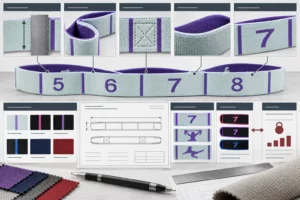
4. Specify Markings, Logos and Attachments
Markings should be supplied as controlled artwork. Include the logo or text file, colour reference, reading direction, repeat or segment sequence, print location, and acceptable alignment.
For numbered bands, provide a simple diagram showing the order and orientation. Ask for a sample that shows the full marking system, not only a cropped section.
Attachments require the same discipline. Record the number of loops or handles, their position, usable opening, reinforcement area, and expected grip.
If packaging includes instructions, labels, cards, or accessories, list these as separate components. All order-specific dimensions, materials, artwork, testing, and delivery conditions still need confirmation for the actual project.
5. Approve the Sample Before Bulk Production
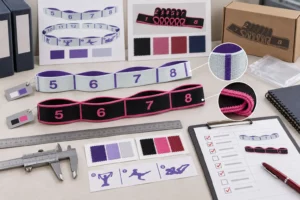
The sample gives the written specification a physical reference. Approval should cover the complete product rather than one isolated feature.
- Dimensions and measurement conditions
- Construction et matériaux
- Colour and surface feel
- Markings and artwork orientation
- Loop or handle layout
- Joined areas and visible finish
- Packaging components
- Any agreed measurement result
Create an approval record that identifies the sample and specification version. Photos can help communication, but they should not replace the physical or controlled reference when colour, feel, stretch, and construction matter.
Changes after approval need a defined route. A new material, width, length, marking layout, loop design, packaging component, or resistance-measurement requirement may justify a revised sample.
6. Common Mistakes When Ordering Custom Resistance Bands
|
Common Mistake |
Why It Causes Problems |
|
Specifying only the width |
Width alone does not define the complete construction or performance requirements. |
|
Using “Light / Medium / Heavy” without a test method |
These labels can mean different things between products and suppliers. |
|
Copying dimensions from another product |
A different structure may require a different length, loop layout, or construction. |
|
Approving only the artwork |
The buyer should approve the complete physical sample, not only the logo or printed design. |
|
Changing specifications after sample approval |
Material, dimensions, markings, packaging or measured-performance requirements may require a new sample. |
7. What Can Be Customized for OEM Resistance Bands?
Depending on the product construction and supplier capability, an OEM project may involve customization of:
- Product dimensions and format
- Material direction or construction
- Resistance requirements
- Colours
- Logo and markings
- Numbered positions or guidance markings
- Loop / handle configuration
- Packaging and printed components
- Sampling and approval requirements
For any specific project, confirm which requirements are fixed, which require supplier recommendation, and which must be verified on the physical sample.
8. OEM Sample Approval Checklist
- Confirm the product form and intended use.
- Confirm finished dimensions and measurement conditions.
- Confirm colour, logo, numbering, and artwork orientation.
- Confirm loop, handle, joint, and edge details.
- Confirm packaging components and labelling context.
- Record any agreed measurement method and acceptance point.
- Identify the approved sample and specification version.
- Require review when a controlled field changes.
Foire aux questions
What should an OEM resistance-band inquiry include?
Include the intended use, product format, finished dimensions, material direction, colour, logo or numbering, loop or handle structure, packaging context, quantity context, and sample requirements. Mark any field that is still open to supplier recommendation.
Should resistance level be specified as a label or a measured result?
State which one you mean. A label or number can identify a position or product level, while a measured resistance result needs an agreed test method, extension point, unit, and tolerance.
What changes require a new sample?
A new sample may be appropriate when material, dimensions, construction, markings, attachments, packaging, or a measured performance requirement changes. The decision should follow the agreed change-control rule.
Can dimensions from one resistance band be reused for another design?
Not automatically. Adjustable bands, continuous loops, and numbered stretch straps may use different length definitions, loop structures, markings, and handling. Specify each product on its own terms.
Ready to Develop Your Custom Resistance Band?
Whether you need a standard resistance band with your logo or a customized OEM design, the first step is to define the product requirements clearly.
Send your intended use, band format, dimensions, material preference, resistance requirements, artwork, packaging needs, and estimated quantity. We can review which specifications are fixed, which need supplier input, and which should be confirmed through sampling.
Request an OEM Quote| Request a Sample


