

How to Choose a Webbing Strap Manufacturer in China
The quote says “webbing straps.” The packing line says rolls. Those are different handoffs. Who cuts the material? Who makes the folded end? Does a sewing partner add the buckle later? Sort that out before comparing the prices. Both quotes may be accurate and still cover different jobs.
|
If the supplier ships… |
The quote should say… |
The first receiving check |
|
A roll |
Material, width, construction, color and roll length |
Identity, width and condition |
|
Cut lengths |
Cut length, tolerance and end condition |
Length and visible edges |
|
Finished straps |
Fold, overlap, stitching, hardware and packing |
Finished dimensions and assembly |
Cutting, sewing and hardware end up on someone’s side of the bill. A roll price may leave them with you; a finished-strap price should show which operations the factory included. Check that scope before totaling the quotes.
В webbing strap range gives you a starting product family. A marked sketch does the harder work: it shows finished width, strap path, buckle opening and stitch line. “Bag strap” is a category. The drawing describes the part.
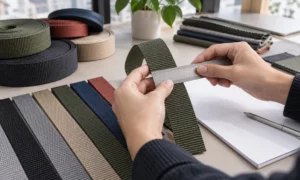
Write the brief around the part you need
Polyester, nylon, polypropylene and cotton each appear in different constructions. If polyester is on your list, the polyester webbing options narrow the search. The material and weave on the sample record should match the quote.
Some parts of the spec are not up for discussion. A buckle opening fixes the pass-through width; approved artwork fixes which face is visible. The weave can stay open until you see the sample. Use the table for the fields you know:
|
Field |
What to put in the inquiry |
|
Использование |
Where the strap sits and what it connects |
|
Finished dimensions |
Width, length, tolerance and how each is measured |
|
Строительство |
Known weave, or “recommend a suitable option” |
|
Assembly |
Fold, overlap, stitch line, buckle or other hardware |
|
Появление |
Color reference, visible face, pattern or logo file |
|
Supply form |
Roll, cut length or completed strap |
|
Quantity |
Sample quantity and expected production order |
An unfinished drawing is still useful. Mark what is fixed and what needs a supplier suggestion. “Weave open” is a decision; a blank cell is a guess waiting to happen.
Use width lists as a first filter
Width lists are useful, but each describes a supplier’s own range. Our webbing tape selection guide lists widths by material and construction; Isson names its standard sizes and custom option:
|
Supplier list |
Listed widths |
What to confirm |
|
Убао |
20, 25, 30, 50 mm |
Availability for the chosen construction |
|
Isson |
15, 20, 25, 38, 50 mm; custom by request |
Finished width and custom lead time |
Say the buckle opening is 30 mm. It appears on one list; on the other, it would be custom. Neither entry proves that a folded strap will pass. Ask for the specific weave at finished width and test the sample in the actual buckle. A loose strip can slide through while a doubled fold binds.
Choose a construction that works in the assembly
If the drawing names a weave, keep the quote to that construction. If it does not, compare samples:
|
Строительство |
What the structure tells you |
What to test |
|
Flat |
Single layer |
Fold bulk and passage through hardware |
|
Tubular |
Hollow, double-wall |
Cross-section and sewn attachment |
Material is a separate choice. Wubao’s guide describes polyester as low-stretch, cotton as softer and breathable, and polypropylene as lightweight where moisture matters. Treat those as starting descriptions. A load or exposure requirement still needs its own test method and acceptance value.
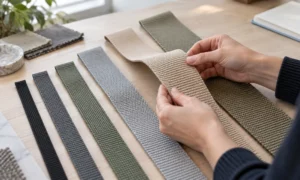
Compare what each manufacturer will actually supply
A manufacturer’s capability list can mix processes that happen at different stages. Isson lists in-house weaving and several finishing processes. For your style, pin down this part of the route:
|
Process |
Put this in the quote |
Sample to review |
|
Weaving |
Строительство и материалы |
Unfinished webbing |
|
Piece dyeing |
Color reference and batch |
Dyed webbing |
|
Sizing or stiffening |
Requested hand or body |
Finished treatment |
|
Screen printing |
Artwork and print position |
Printed surface |
|
Heat transfer |
Artwork and transfer location |
Transferred sample |
Check the version made after the last finishing step. If printing happens off-site, name the party that reviews the returned webbing and keeps the approved sample. That is the reference the production order needs.
If strength belongs in the brief, ask every manufacturer to use the same test method and acceptance value. The result should identify the specimen, width and preparation. A specification sheet that lists only a tensile number leaves out the conditions needed to compare it.
Read a supplier’s specification sheet by style. A row for one webbing construction cannot stand in for another. It can still show which questions to ask: Is the material named? Are width and thickness shown? Does the entry list weight, denier or tensile strength? Mark each field as stated, missing or different from your drawing. For an unlisted thickness or weight, ask whether it can be provided for the sample being quoted. For strength, request the units, specimen width, preparation and test method; put your acceptance value beside them. A range needs the same context. Ask whether it covers the offered weave and finishing route. Keep this comparison with the sample code. If a later quote uses another style name, compare its listed fields before assuming the items are equivalent. Request the current sheet for the exact construction in the quote.
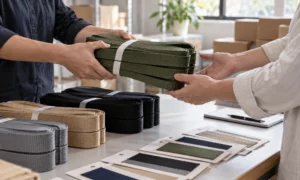
Decide what the sample is meant to prove
Before the sample arrives, label the question it needs to answer. “Looks good” covers too much.
Use the sample against the specific question. Keep one approval from standing in for another:
|
Question |
Check |
Record |
|
Is width right? |
Same points on the drawing |
Measured width and tolerance |
|
Does it fit? |
Actual buckle, including the folded strap |
Hardware and assembly used |
|
Is color right? |
Physical reference, steady light |
Reference code and reviewer |
|
Is the finish right? |
Surface after final process |
Sample code and date |
|
Does it meet strength? |
Agreed test, not a hand pull |
Method, specimen and result |
A sample can show its face, edge, thickness and fit. A certificate or test report needs its own scope check: date, material and product style. A report for a related item may not cover this strap.
Put the approved version into the order
When the sample passes, label the physical piece and save its drawing revision, date and any accepted variation. Then tie the same code to the purchase order:
|
Order field |
Approved reference |
|
Material and construction |
Sample code and specification revision |
|
Dimensions and tolerance |
Current drawing |
|
Finish, logo or hardware |
Approved sample after finishing |
|
Packing and receiving check |
Buyer’s order record |
|
Substitution authority |
Named approver and written sign-off |
Keep the physical sample with its revision number; a photo cannot show thickness or hand feel. If material or stitching changes, label the earlier sample as superseded. Purchasing and production should both be able to find the current version.
В OEM and ODM webbing services page outlines the general move from sampling through production and shipping. Confirm the records and handoffs for your order with the team. A drawing revision should reach the person preparing production, with the approval attached; otherwise an old version can remain in circulation.
The quote itself will not tell you when production or dispatch begins. Ask for a date sequence for sample review, approval, production and shipping. Include your delivery window if one is fixed.
If the drawing is still in progress
Send the dimensions already settled, show the hardware or seam, and mark open points. Ask the manufacturer to confirm its interpretation before approving a sample. A marked-up photo can carry the first discussion; the production drawing should carry the final tolerances.
When you contact our team, include the application, target dimensions and any drawing or reference sample. State what the strap must fit and what work belongs in the quote.


