

Resistance Band Material Options: Natural Latex vs. TPE for OEM Programs
The difficult part of a latex versus TPE inquiry is deciding what, exactly, is being compared. Take two quotations for a fabric band. They can use the same product description while referring to different elastic cores or including different accessories.
Until that is resolved, the material comparison has a hole in it.
The buying brief can settle part of the question before any stretching begins. Where it excludes natural rubber latex, put that proposal aside. Where either route remains possible, start with the drawing, the supplied components and the evidence accompanying the sample.
That gives the two offers something concrete in common.
Nossa resistance band range helps identify the fabric format you have in mind. You can refer to a pictured format when sending a custom inquiry, with the requested changes marked on the drawing. We still need to confirm the material details for your particular construction.
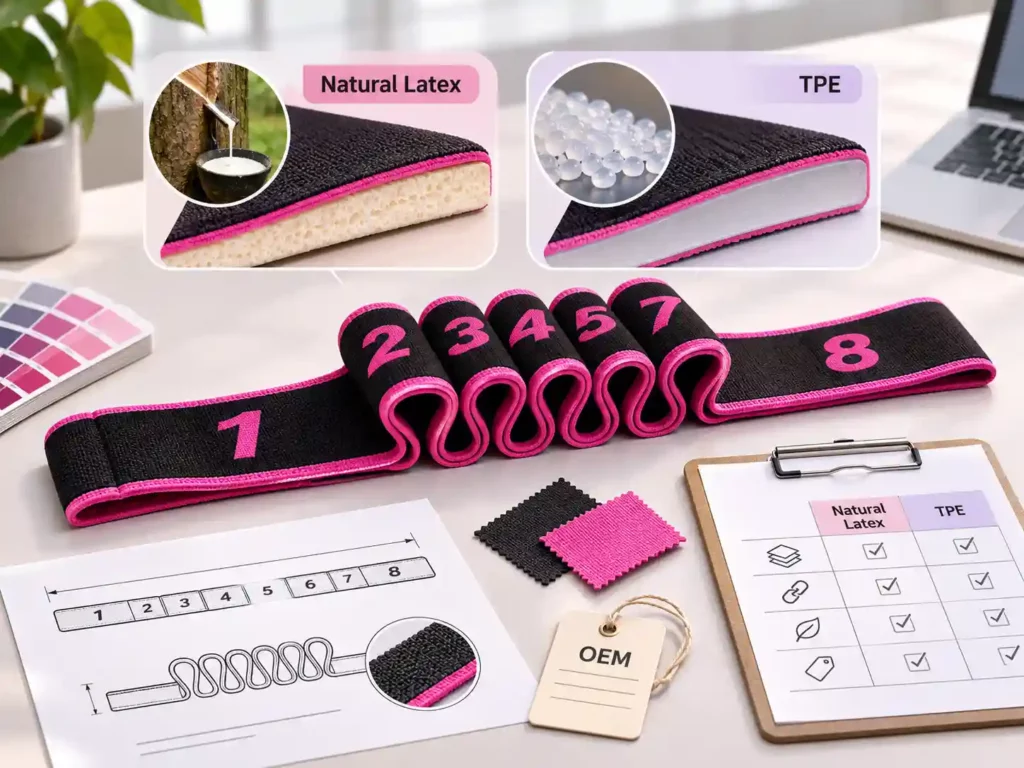
What does the material line actually cover?
Natural rubber latex originates in the rubber tree, Hevea brasiliensis. On a supplier’s declaration, the next question is where that material appears. Think of a core inside a fabric sleeve: the declaration might identify either part, or both. An attached grip adds another component to account for.
With TPE, the first unanswered question may be the formulation itself. The families and grades in Avient’s thermoplastic elastomer overview show why the category name is too broad to finish a purchasing specification.
The supplier still has to name the proposed grade and its place in the assembly.
Avient’s explanation of thermoset natural rubber and thermoplastic TPE helps with the processing vocabulary. Buyers should keep that background separate from product approval. A claim about resistance or service life has to be supported by the finished band being offered, whatever processing category its material belongs to.
There is a similar gap between a material name and an environmental claim. The complete item may contain textiles or attached parts. Disposal also depends on collection arrangements in its destination market. Avoid approving recycling copy from the abbreviation TPE alone.
Nossa adjustable fabric band illustrates the distinction between a material and a construction. The page shows integrated loops and numbered settings. It identifies that format; it is not a composition declaration for any band built to look similar.
At this stage, the comparison has only a few firm differences. The table separates those from questions that remain open for both routes.
|
Material screening point |
Natural rubber latex route |
TPE route |
|
What the name identifies |
Rubber-tree origin |
A category spanning families and grades |
|
Processing background in Avient’s overview |
Thermoset |
Thermoplastic |
|
Buyer excludes natural rubber latex |
Set this proposal aside |
Check the proposed formulation and covered components |
|
Finished-band resistance or durability |
Requires product evidence |
Requires product evidence |
|
Recycling claim for an assembled band |
Unresolved by the name |
Unresolved by the name |
Follow this screening with the supplier’s actual proposal. Keep its wording for each component: changing “elastic core” to “band” in your notes could enlarge the statement’s scope. Attach the drawing revision and sample reference so the material answer stays connected to the offered item.
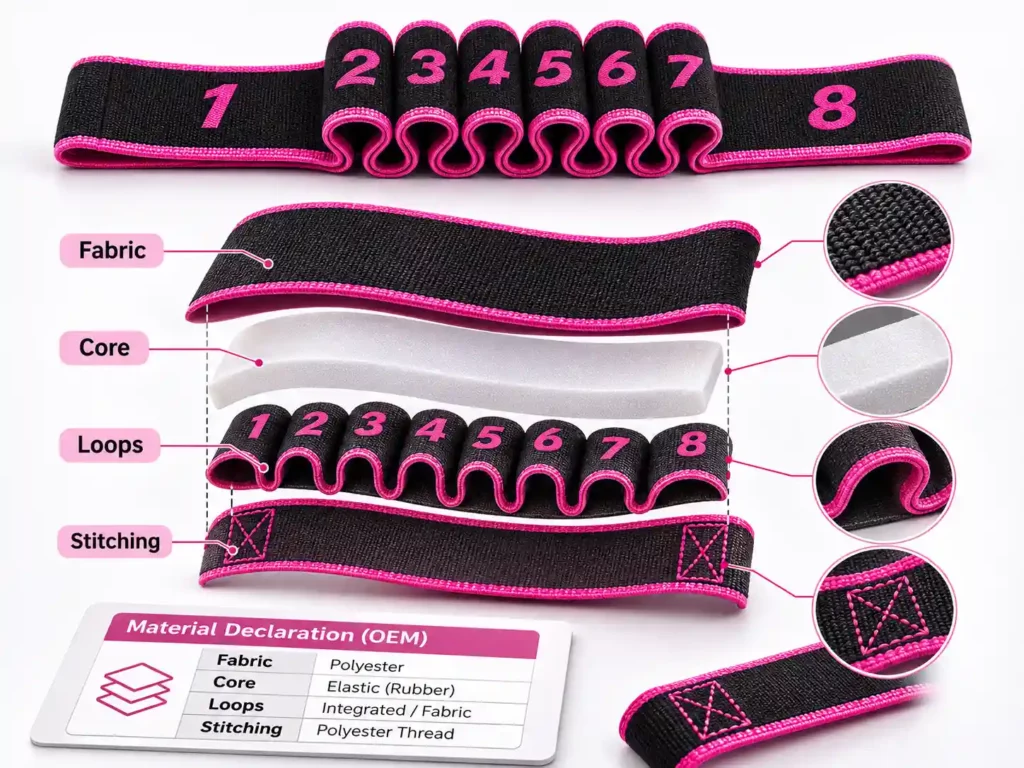
How should a buyer phrase a latex exclusion?
The exclusion needs a defined boundary. Some inquiries concern the band body; others cover every supplied part, including a grip or pouch. Those are different requests. Put the intended boundary beside the drawing so the supplier knows which components require an answer.
Consider a drawing with a band and grip, followed by a declaration that names the body only. The body’s answer can stay in the file while the grip remains open.
This is a scope gap to resolve with the supplier, rather than a reason to copy the body’s status across the assembly.
There is a limit to the FDA reference used here. Its discussion of the phrase latex-free concerns medical-product labelling and how the phrase may be understood. We have included it as background on wording; it does not establish a fitness-band labelling rule.
Before approving retail copy, give the brand’s reviewer the supplier’s full declaration. A line lifted from that document may lose a qualification about the parts covered. Review the intended wording for the destination market with that qualification visible, rather than supplying the favourable phrase on its own.
A retailer’s prescribed text belongs in the original inquiry. If it includes accessories, the supplier needs to see that clause as well as the core-material question. Follow-up can then name the unanswered component directly, without another exchange about what the buyer meant by the product.
Nossa OEM specification guide covers the wider inquiry. Keep the material restriction attached to the drawing as those other details develop. A change to the construction may require another answer, even when the product name stays the same.
How can the samples be compared fairly?
Two samples can feel different for reasons beyond their material labels. Width, thickness and the starting span belong beside the force reading. If geometry differs, the result describes those samples together with their construction differences. It cannot isolate the material’s contribution.
Sample identification comes before the comparison. The piece on the desk needs a reference that connects it to the offer and declaration. Using colour alone leaves room for confusion between similar pieces; a separately identified replacement preserves the distinction between the two reviews.
For a numerical comparison, agree on the method and extension point. Values obtained at different points describe different conditions. Put them in separate rows until a matched comparison is available, rather than ranking them as equivalent results.
The buyer’s observations have a place beside the numbers. Feel, odour and visible marks can be recorded for the piece received, with their subjective nature clear. A comment about that specimen should not become a general verdict on latex or on all the grades covered by TPE.
If repeated stretching matters to the order, it needs an agreed product evaluation. The supplier or a qualified laboratory can discuss that evaluation against the proposed band. Leave detailed procedures in the test plan.
There is no cycle target to extract from the words natural latex or TPE.
Choosing between two specimens and supporting a retail statement are different jobs for evidence. State which job the evaluation serves.
The purpose, sample ID, method revision and result should remain together, allowing a reviewer to see whether a later claim asks more of the evidence than the original comparison did.
A second sample can reopen the comparison. Check its measurements and paperwork instead of copying the first sample’s notes into the new row. Otherwise the team may approve one piece while the order file still describes another.
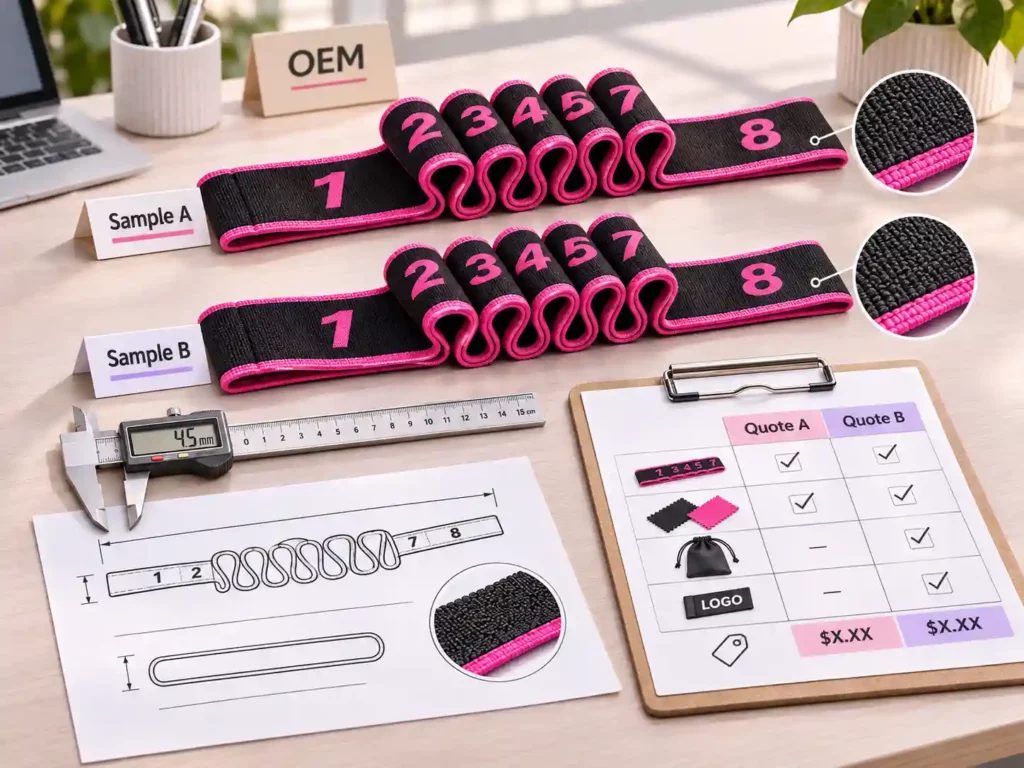
How should quotations be compared?
One offer may cover a loose band; another may include printing and a pouch. Calling the difference a latex premium or a TPE saving would be premature. Align the quantities, included parts and packing work first, with freight and tooling identified wherever they affect only one total.
Both inquiries need the same drawing reference. Each offer can then carry its component materials, selected grade and matching sample reference. Where the grade is still open, the commercial comparison remains qualified until the supplier explains what the quoted amount would buy.
Not every entry in a brief has the same status. Colour may be a preference the buyer is willing to revisit after sampling. A material exclusion is a condition of the order as it stands.
A cheaper proposal still needs to meet it, or the buyer needs to revise the brief explicitly.
An inquiry to Wubao can include open material questions directly on the proposed construction. We can address those questions with the inquiry instead of leaving them detached from the quoted item. If the grade is still undecided, keep that qualification beside any planning amount discussed.
Keep environmental wording out of the cost comparison until its support is clear. Neither “natural” nor TPE tells a customer how to dispose of the assembled band. If that claim matters to the programme, ask for evidence covering the item and intended market.
What belongs on the final decision record?
The decision should be readable without a meeting. Put the selected sample reference beside the drawing revision, covered components and declaration. Then write the selection reason. If an unresolved limitation was accepted, leave it in the note instead of allowing it to vanish from the summary.
Keep a reason for setting the other proposal aside. Missing information leaves a question to answer; an exclusion in the brief closes that route for the current order. These outcomes have different implications if someone wants to revisit the choice later.
To discuss the requirements, send the format and drawing or sample reference, together with the material restriction and proposed retail wording. We can then address the construction and available material information for that inquiry.


